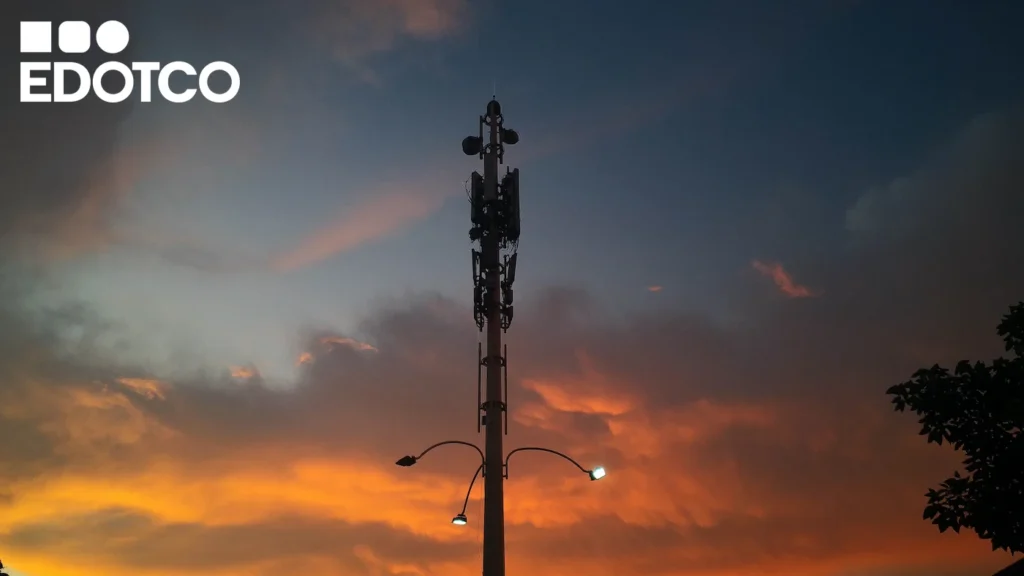
Osiris Global has agreed to buy EDOTCO Towers Pakistan, a company that owns around 3,000 telecom towers across the country, in a deal worth an illustrative US$95 million. The agreement was signed on 23 November 2026, but the sale is not complete yet. It still needs approval from Pakistan’s regulators, and completion is targeted for the last quarter of 2027.
What Was Agreed
Osiris Global Limited, a Hong Kong-registered company, signed a conditional sale and purchase agreement on 23 November 2026 to buy a 100% stake in EDOTCO Towers Pakistan (Private) Limited. The seller is EDOTCO Investments (Labuan) Limited, a subsidiary of Malaysia’s Axiata Group Berhad. The consideration is entirely in cash.
The agreement is conditional, which means the sale will only go through if a set of conditions is met, including regulatory approvals. Until then, EDOTCO Towers Pakistan continues to operate under its present ownership.
There is a separate, parallel deal in the same announcement: Osiris is also buying a 70% stake in EDOTCO Bangladesh, which operates around 17,000 towers, for an illustrative US$325 million. The Pakistan sale is independent and can complete on its own; the Bangladesh sale is linked to other EDOTCO sales in the Philippines and Indonesia.
Who Is Osiris
The Osiris Group is a Bangladesh-focused private equity firm, backed by global investment partners. It also runs a data-centre business in Bangladesh. The actual buyer named in the deal is Osiris Global Limited, the Hong Kong-based holding company of The Osiris Group.
Osiris is not a telecom operator. It is a private-equity buyer moving into the tower business, which is a different kind of investment from running a mobile network. The towers it is buying are shared infrastructure: equipment from several mobile operators sits on the same towers, and the operators pay to lease space on them.
The Deal Value
The price is an illustrative US$95 million, which is about RM384.3 million. This is not a final, locked price. It is made up of a base component of US$92 million, which will be adjusted at completion for net working capital, cash, debt-like items and designated intragroup receivables. The final figure will therefore be different from US$95 million.
The illustrative figure was calculated from EDOTCO Towers Pakistan’s audited financial results for 2025. Osiris’s own press release disclosed no financial terms at all.
For context, EDOTCO Towers Pakistan contributed about RM138.1 million, or around 1.17%, of Axiata’s group revenue in 2025, with profit after tax of about RM21 million. Axiata said the proceeds from the sale will be used entirely to repay borrowings within 12 months. Axiata expects about RM2.2 billion in gross proceeds from its wider EDOTCO restructuring, which implies a total value of around RM11.8 billion for EDOTCO as a whole.
What Happens Next
Before the sale can complete, several approvals and steps are required:
- State Bank of Pakistan approval
- Competition Commission of Pakistan (CCP) approval
- Pakistan Telecommunication Authority (PTA) approval
- Foreign-exchange clearance from an authorised dealer
- Consents from certain lenders, noteholders and sukukholders, including the release of the seller from standby letter-of-credit obligations
- Execution of a local share sale agreement and incorporation of a local buyer nominee at least 30 days before completion
Axiata also needs shareholder approval at an extraordinary general meeting for the wider restructuring. Regulatory applications are targeted for submission by the end of January 2027, and completion is targeted for the fourth quarter of 2027. The long-stop date — the last date by which the deal must complete — is 12 months after the agreement was signed, around 23 November 2027.
What It Means for Mobile Users
There is no immediate impact on mobile users. No source has stated any change to calls, data or signal quality as a result of this deal, and none should be expected in the short term. The deal is a change of tower ownership, not a change to any operator’s network. Operators lease space on shared towers, and their contracts and sites continue under the new owner.
Osiris has announced no separate investment or 5G expansion plan for the Pakistan towers. Its data-centre and tower-linking plans were described only for Bangladesh. So this deal should not be read as a 5G boost or an investment boost for Pakistan’s mobile networks.
Background
This is not the first time a big tower deal has been attempted in Pakistan. In 2017, EDOTCO tried to buy Jazz’s roughly 13,000 towers together with Dawood Hercules in a deal worth around US$940 million. That deal was called off in 2018 after the required regulatory approvals were not secured.
That history matters: regulatory approval in Pakistan is a genuine hurdle for tower deals, not a formality. The Osiris deal still has to pass the State Bank, the CCP and the PTA before it can close.
Frequently Asked Questions
Who is buying EDOTCO Towers Pakistan?
Osiris Global Limited, the Hong Kong-based holding company of The Osiris Group, a Bangladesh-focused private equity firm.
How many towers are involved?
Around 3,000, according to Osiris’s press release and news coverage. The stock-exchange filing summary states the company operates more than 2,500 towers.
How much is the deal worth?
An illustrative US$95 million, based on a US$92 million base component that will be adjusted at completion. The final price will differ.
Is the sale complete?
No. The agreement was signed on 23 November 2026, but completion is conditional on approvals from the State Bank, CCP and PTA, among other conditions. Completion is targeted for the fourth quarter of 2027.
Will this affect my mobile service?
No immediate change has been announced. The towers are shared infrastructure used by several operators, and their contracts and sites continue under the new owner.
Conclusion
The Osiris-EDOTCO deal is a significant transaction for Pakistan’s telecom infrastructure: a private-equity buyer is taking over around 3,000 shared telecom towers in an illustrative US$95 million deal. But it is a signed agreement, not a done deal. With three regulators still to clear it and completion targeted for late 2027, the real test is whether the approvals come through — something that sank the last big tower deal in Pakistan.