If your mobile signal disappears every time the electricity goes out, you are not alone. In many parts of Pakistan, a power cut often means weak signals, failed calls and no mobile internet until the power returns. The Pakistan Telecommunication Authority (PTA) now wants to change that, starting with a formal consultation rather than a sudden new rule.
PTA has opened an industry consultation on moving mobile towers, known as BTS sites, to solar power, battery storage and hybrid energy systems. The consultation paper appeared on 24 November 2026, and operators, tower companies and other stakeholders have until 4:30pm on 7 December 2026 to send in their comments. This is a proposal under discussion, not a final order, so users will see no immediate change in bills, packages or coverage.
That distinction matters. Headlines about “mandatory solar” can sound like towers will change overnight, but PTA has not made anything mandatory yet. It has asked the industry a serious question: should solar become compulsory at the towers that suffer the most power cuts, and how fast should the change happen? The answers given by 7 December will shape the final roadmap.
What PTA Proposed
PTA has proposed a phased, technology-neutral shift of Base Transceiver Stations (BTS) to alternative energy. A BTS site is the tower or facility your phone connects to for calls and mobile data. Under the proposal, these sites would gradually move to solar power, solar-battery systems, or solar-diesel-battery hybrid systems, depending on what suits each site.
Instead of one uniform deadline for every tower, PTA wants each operator to identify its problem sites, check whether solar can work there, and propose its own investment plan with a timeline of one, two or three years. The aim is a sector-wide roadmap under Clause 7.9.1 of the Telecom Policy 2015, built on real site data rather than guesses.
The consultation covers cellular mobile operators, tower infrastructure providers, tower companies and equipment vendors, along with energy providers and government agencies. Responses go to renewable_energy@pta.gov.pk. PTA is also looking at possible incentives, including tax relief, easier imports of renewable-energy equipment, support for local manufacturing and carbon credits.
Why Solar for Towers
Towers cannot switch off when the power goes out. A mobile tower must keep running around the clock, because people depend on it for calls, messages, mobile banking, work and emergencies. When grid electricity fails, towers today fall back on batteries and diesel generators.
That backup system has three big problems. First, diesel is expensive, and fuel prices keep changing, pushing up the cost of running a network. Second, generators need regular fuel supply and maintenance, which is difficult and costly at remote or off-grid sites. Third, batteries alone only last for a limited time, so during long power cuts the tower can still go down once the battery runs out.
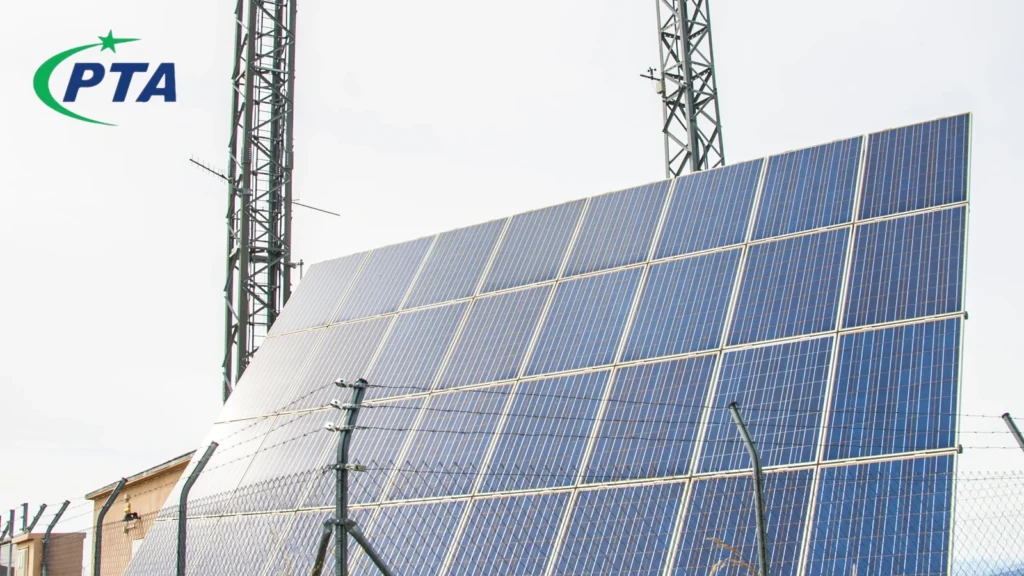
Solar power, paired with enough battery storage, addresses all three problems. Panels generate electricity during the day, batteries store it for the night, and a hybrid setup can still use the grid or a generator when needed. Over the life of the system, solar can be cheaper than running a diesel generator every day, and it cuts carbon emissions too.
There is a wider context. Operators have separately been pressing the government for cheaper industrial electricity tariffs, arguing that commercial rates have pushed up operating costs. In a joint letter dated 1 October 2026, the chief executives of Jazz, Zong, PTML (Ufone and Telenor) and PTCL asked for intervention on tariffs. Power is one of the biggest running costs for mobile networks, and unreliable power is one of the biggest threats to service quality.
What Operators Must Do
The consultation asks operators for detailed, site-level information, not general promises. For each BTS site, operators must report the accumulated power outages over the previous 30 days, along with the site’s location, whether it is grid-connected or off-grid, and what backup arrangements already exist.
That data must be compiled at four levels: union council, tehsil, district and national. A single national average would hide the real problem, since a tower in an area with reliable electricity faces very different challenges from one in an area with daily load-shedding. PTA wants to see that difference clearly before it sets any rule.
Operators must also identify suitable alternative energy solutions for individual sites and propose timelines of one, two or three years. Each operator must identify the 10 percent of its sites with the highest diesel consumption and propose a plan to gradually reduce their diesel use. PTA has also asked for coordination with energy-sector institutions, including NEPRA and power distribution companies, to improve electricity reliability for telecom sites over the next five years. Shared solar systems for towers used by multiple operators are also under consideration, which could lower costs by avoiding duplicate investment. Progress would be tracked through a standard annual reporting system.
The 5% Outage Rule
The most talked-about part of the proposal is the 5 percent outage threshold. PTA has proposed identifying sites that face power outages of 5 percent or more in a month, within a union council, as high-outage locations, and is asking whether solar installations should become mandatory at such sites.
In plain terms, 5 percent of a month is about 36 hours without grid power in a month. A tower that loses power for that long, month after month, spends a large part of its life on backup power. Under the proposal, such sites could be required to install solar systems with enough battery storage to keep services running through the night, during cloudy weather and even during snowfall.
It is important to be clear: this is a question in a consultation paper, not a rule. PTA has not made solar mandatory at high-outage sites and has not announced any specific conversion targets or a fixed rollout schedule. PTA itself has noted that a uniform obligation for every BTS site may not be practical, because sites differ in grid reliability, location, investment needs and commercial viability. If operators show the threshold is too strict or too loose, PTA can adjust it before any final decision.
What It Means for Mobile Users
For mobile users, the short answer is: nothing changes right now, but the long-term effect could be positive. The consultation does not change today’s network rules, quality standards or tariffs. Package prices, call rates and data bundles stay the same, and no tower will suddenly switch to solar next week.
The benefit, if the plan goes ahead, would show up gradually. Fewer towers going down during load-shedding would mean fewer dropped calls, fewer “no service” moments and more reliable mobile internet during power cuts. This would matter most in smaller towns, rural areas and off-grid locations, where users feel every power failure on their phones.
There is also a cost angle worth watching. Diesel is a major running cost for operators, and lower running costs can, over time, ease pressure on the prices users pay. But no one should expect cheaper packages as a direct result of this consultation. Any savings would come slowly, and only after operators actually invest in solar systems. PTA has not linked the proposal to any change in tariffs.
Users should not expect a quick fix either. Even if PTA makes solar mandatory at high-outage sites, operators would get one to three years to convert sites, and the worst sites would come first. The change would be visible tower by tower, area by area, not all at once across the country.
What Happens Next
The next step is the comment deadline: 4:30pm on 7 December 2026. After that, PTA will review the industry’s feedback and the site-level outage data, and decide whether to set conversion targets or introduce a formal requirement through a new regulatory order.
Users who want to follow the issue should watch for three things after 7 December: whether PTA keeps the 5 percent threshold or changes it, whether it announces firm conversion targets or deadlines, and whether incentives such as tax relief or easier imports for solar equipment are actually introduced. If you live in an area where the signal regularly dies with the electricity, this consultation is directly about your problem, and its outcome will decide how quickly your local towers get a more reliable power supply.
FAQs
Is solar power now mandatory for all mobile towers in Pakistan?
No. PTA has only opened a consultation and asked for industry feedback. No requirement has been made mandatory, and no specific conversion targets have been announced yet.
What is the 5% outage rule PTA is proposing?
PTA has proposed treating sites with power outages of 5 percent or more in a month, within a union council, as high-outage locations. It is asking whether solar installations should become mandatory at such sites, with enough battery storage to keep services running at night and in bad weather.
When is the deadline for comments on the PTA consultation?
Comments and site-level data must be submitted by 4:30pm on 7 December 2026, to renewable_energy@pta.gov.pk.
Which operators and companies are affected by the proposal?
All cellular mobile operators, tower infrastructure providers, tower companies and equipment vendors are invited to respond. It affects the networks behind Jazz, Zong, Telenor and Ufone, as well as the tower companies that host their equipment.
Will my mobile package prices or coverage change because of this?
No, not immediately. The consultation does not change tariffs, packages or coverage. Any improvement in coverage during power cuts would come gradually, over one to three years, if and when operators install solar systems.
Why are telecom towers still using diesel generators?
Towers must run 24 hours a day, so when grid power fails they need backup. Batteries only last for a limited time, so diesel generators keep the tower running during long outages, especially at remote or off-grid sites. Solar with battery storage is meant to reduce that dependence.
Conclusion
PTA’s solar proposal is a sensible response to a problem every mobile user in Pakistan understands: when the power goes, the signal often goes with it. By asking operators for real outage data and phased investment plans, instead of imposing a sudden blanket rule, PTA has given the industry a chance to shape a practical roadmap.
The key date is 7 December 2026. Until the comments are in and reviewed, nothing is final, and users should not expect instant changes to their bills or coverage. But if the consultation leads to firm rules and real investment, the towers that fail most often during load-shedding could be the first to get solar panels and batteries, and that would mean fewer dead zones during power cuts.