
Samsung Holographic Display Leak Hints
Samsung may be preparing a completely new type of smartphone display that goes beyond foldable screens and traditional OLED technology. A recent leak claims the company is internally developing a Samsung holographic display system that could bring glasses-free 3D visuals to future smartphones.
The leak was shared by Schrödinger, also known as @phonefuturist on X. According to the information, Samsung’s project carries the codename MH1 or H1 and may use advanced holographic technology to create floating visual effects directly on smartphone screens.
- Samsung reportedly working on holographic display system
- MH1 or H1 codename mentioned in leak
- Technology may support glasses-free 3D visuals
- Research project still in early development stage
You Can Also Read: Lenovo K12 Price in Pakistan, Specifications, Features, and Full Review
| Feature | Expected Details |
|---|---|
| Technology Name | Samsung Holographic Display |
| Project Codename | MH1 / H1 |
| Main Feature | Glasses-Free 3D Effects |
| Core Technologies | Eye Tracking and Beam Steering |
| Display Type | Holographic Smartphone Screen |
| Development Status | Early Research Phase |
What Is Samsung Holographic Display Technology?
Samsung holographic display technology is reportedly designed to create depth and spatial visuals without requiring special glasses or external accessories. Unlike traditional flat smartphone displays, this system could allow users to view digital objects from different angles simply by moving or tilting the device.
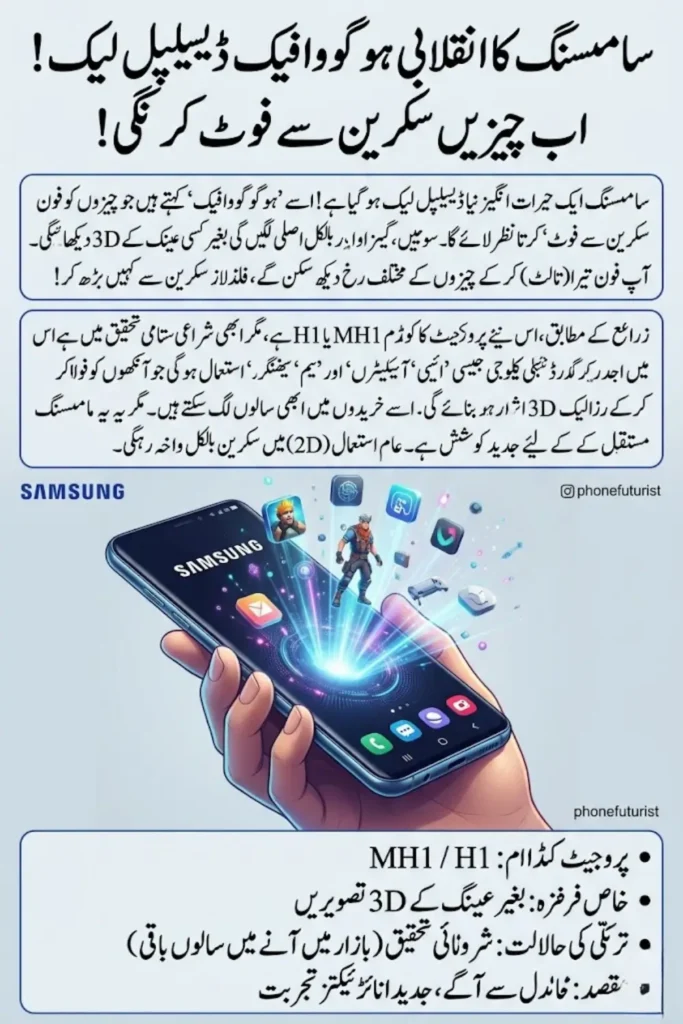
The leak suggests Samsung is combining a nanostructured holographic layer with eye tracking and beam steering systems. These technologies work together to direct light accurately toward the user’s eyes, creating a more realistic 3D effect.
- Holographic layer may create depth effect
- Eye tracking could improve viewing stability
- Beam steering may guide light precisely
- Users may view floating digital objects
Earlier glasses-free 3D systems often struggled with blurry visuals and limited viewing angles. Samsung reportedly wants to solve those problems by improving accuracy and maintaining display quality.
You Can Also Read: Xiaomi 17 Ultra Price in Pakistan, Specifications, Features and Full Review
How Samsung Glasses-Free 3D Display Could Work
According to the leak, users may experience a more interactive viewing system where digital elements appear to float above the smartphone screen. Instead of looking at a flat image, users could see objects with visible depth and perspective changes.
The display may also preserve full screen resolution during normal 2D usage. This is important because many older 3D display technologies reduced picture quality when switching between standard and 3D viewing modes.
- Tilting phone may change viewing angle
- Floating UI elements could become possible
- Full 2D resolution reportedly preserved
- More immersive visual interaction expected
Samsung’s beam steering technology is believed to play a major role in stabilizing the 3D effect. By directing light accurately, the display could remain clear even when the user changes viewing position slightly.
Samsung’s Research Is Still in Early Stages
The report indicates that Samsung holographic display technology is still under research and development. Commercial products using the system may still be years away, and there is no official confirmation from Samsung yet.
The smartphone industry has tested glasses-free 3D displays before, including devices like the Nintendo 3DS. However, older systems often suffered from inconsistent visuals and uncomfortable viewing experiences.
- Project currently under development
- No official launch timeline confirmed
- Commercialization may take years
- Earlier 3D devices faced major limitations
Samsung appears to be studying ways to improve user comfort, image stability, and hardware efficiency before bringing the technology to mass production.
You Can Also Read: Xiaomi 17 Price in Pakistan, Specifications, Features, and Full Review
| Technology Area | Possible Purpose |
|---|---|
| Eye Tracking | Stable viewing angles |
| Beam Steering | Better light direction |
| Holographic Layer | 3D depth creation |
| Spatial Visuals | Floating interface effects |
| 2D Resolution Support | Normal display clarity |
Samsung’s History of Display Innovation
Samsung has played a major role in smartphone display development for many years. The company helped popularize foldable OLED screens and continues to invest heavily in next-generation display systems.
The company has also experimented with spatial displays and glasses-free 3D monitors in other product categories. This experience could help Samsung develop more advanced smartphone displays in the future.
- Samsung pioneered foldable OLED displays
- Company researching spatial display systems
- Previous work includes 3D monitor technology
- Display innovation remains company priority
Samsung recently introduced hardware-based viewing angle control technology with the Samsung Galaxy S26 Ultra. Similar systems may soon appear in flagship devices from brands like Xiaomi, Oppo, and Vivo.
You Can Also Read: Xiaomi Redmi Note 15 Pro Price in Pakistan, Specifications, and Full Review
Future Possibilities for Samsung Holographic Display
If the MH1 project reaches commercial production, Samsung holographic display technology could change how people interact with smartphones. Spatial interfaces may allow floating app controls, immersive gaming, and advanced mixed reality experiences.
The leak also mentioned the possibility of a future “Spatial iPhone,” suggesting companies like Apple could eventually adopt similar technology. This could open new opportunities for mixed reality devices and digital ecosystems.
- Spatial gaming experiences may improve
- Floating UI elements could become common
- Mixed reality integration may expand
- Smartphone interaction could become more immersive
The technology may also work alongside devices like Apple Vision Pro, creating stronger connections between smartphones and mixed reality platforms.
Challenges Samsung May Face
Even though the technology sounds impressive, several challenges still exist before holographic smartphone displays become mainstream. Hardware limitations, battery usage, and production costs could slow development.
Creating stable 3D visuals on small smartphone screens is technically difficult. Samsung will likely need advanced processors and efficient power management systems to support the technology properly.
- High production costs possible
- Battery consumption may increase
- Hardware requirements could be demanding
- Stable 3D visuals remain technical challenge
Many companies have tried glasses-free 3D systems before, but few succeeded commercially. Samsung’s research may determine whether the technology finally becomes practical for everyday smartphone users.
You Can Also Read: Xiaomi Poco M8 Pro Price in Pakistan, Specifications, and Full Review
Why Samsung Holographic Display Matters?
The smartphone market is becoming increasingly competitive, and brands are searching for new ways to stand out. Foldable phones introduced one major change, and holographic displays could become the next step in mobile innovation.
For users, this technology may eventually provide more interactive entertainment, advanced gaming, and improved visual experiences without needing separate headsets or accessories.
- Smartphone innovation moving beyond foldables
- Interactive displays may become future trend
- Gaming and entertainment could improve
- New user experiences may emerge
As companies continue investing in spatial computing and mixed reality, Samsung holographic display technology may become an important part of future mobile devices.
FAQs
What is Samsung holographic display technology?
Samsung holographic display technology is a rumored smartphone display system designed to create glasses-free 3D visuals using holographic layers and eye tracking.
What is the MH1 or H1 project?
MH1 or H1 is the reported codename for Samsung’s holographic smartphone display research project currently under development.
How does Samsung glasses-free 3D display work?
The system may combine beam steering, eye tracking, and holographic layers to create depth effects directly on smartphone screens.
Is Samsung developing holographic smartphones?
Leaks suggest Samsung is researching holographic smartphone display technology, but no official product has been confirmed yet.
Will Samsung holographic displays need special glasses?
No, the leaked information claims the technology is designed to provide 3D effects without requiring glasses.
When could Samsung holographic display phones launch?
The project is reportedly still in early research stages, so commercial smartphones using the technology may still be years away.
Final Thoughts
Samsung holographic display technology could represent the next big shift in smartphone screens after foldable devices. While the project is still experimental, the idea of glasses-free 3D visuals on a smartphone is already attracting attention across the tech industry.
If Samsung successfully solves the challenges of stability, power efficiency, and viewing quality, future smartphones may offer experiences that feel much closer to mixed reality than traditional mobile screens.
You Can Also Read: Xiaomi 15 Ultra Price in Pakistan, Full Specifications, Features, and Performance Review