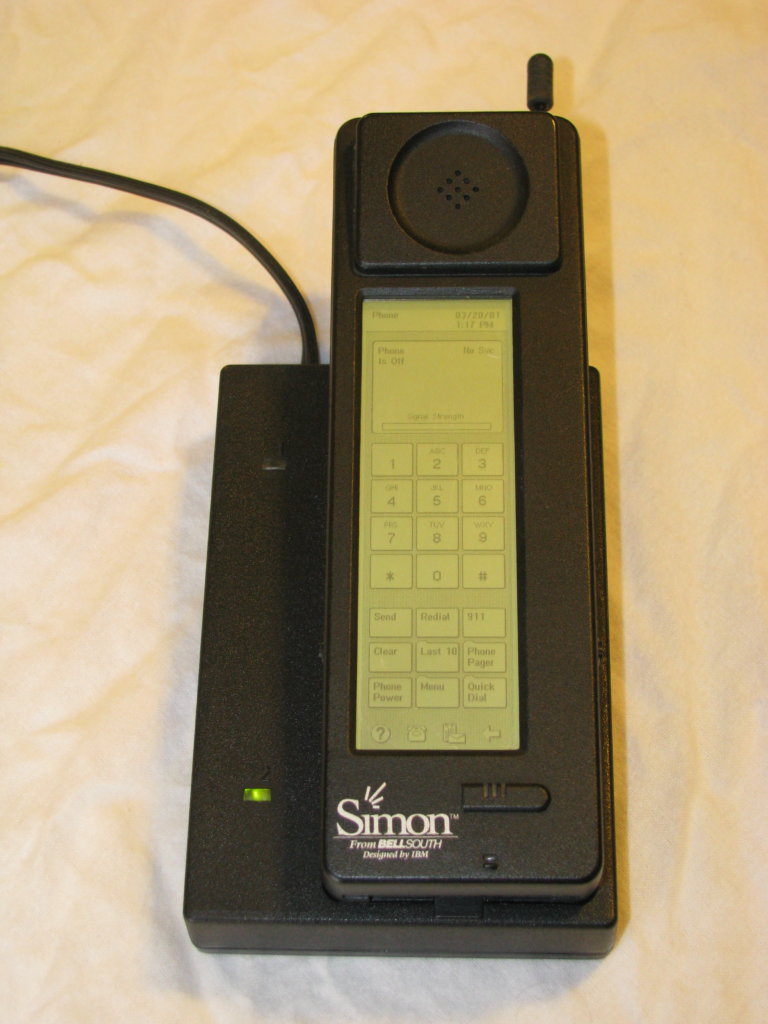
Long before the iPhone and Android phones, there was a large black device with a touchscreen, a stylus and an aerial. It could send emails, send faxes, keep a calendar and run small apps. That device was the IBM Simon Personal Communicator, known simply as the Simon. Today it is remembered as the world’s first smartphone.
Simon matters because it brought together two ideas that had been separate: a mobile phone and a personal digital assistant (PDA). A PDA was a small handheld device for notes, contacts and calendars. Simon put those tools inside a phone. The result looked strange at the time, but it pointed directly to the smartphones we all use today.
This article tells the full story of Simon: how it was revealed, how it went on sale, what it could do, why it failed, and why it still matters more than 30 years later.
The Story of the Simon
Simon began inside IBM. It was designed by IBM and manufactured by Mitsubishi Electric. It was sold in the United States by BellSouth Cellular. Its code name during development was “Angler”.
The public first saw Simon at COMDEX in Las Vegas on 16 November 1992. COMDEX was a large computer trade show. At that time, most people had never seen a phone with a touchscreen. Simon was shown as a concept for a phone that could do much more than make calls.
It took almost two years for the idea to reach the shops. Simon went on sale on 16 August 1994 in the United States. It was sold with a two-year contract for US$899, or for US$1,099 without a contract. That was a very high price in 1994, and it was one of the reasons Simon stayed a niche product.
Simon was discontinued in February 1995, only about six months after it went on sale. Only 50,000 units were sold. By modern standards, that is a tiny number. But Simon’s short life does not make it a failure in history. It proved that a phone could be a computer in your pocket, even if the world was not ready for it yet.
The word “smartphone” was not coined until later, in 1995 and afterwards. Nobody called Simon a smartphone when it was on sale. It is only in retrospect, looking back at what it could do, that Simon is called the first smartphone.
Simon Mobile Specifications
The table below lists the verified specifications of the IBM Simon. By today’s standards, they look very modest. In 1994, they were remarkable for a device you could carry in your hand.
| Specification | IBM Simon |
|---|---|
| Full name | IBM Simon Personal Communicator |
| Designed by | IBM |
| Manufactured by | Mitsubishi Electric |
| Sold by | BellSouth Cellular (United States) |
| First shown | 16 November 1992, COMDEX, Las Vegas (code name “Angler”) |
| Released | 16 August 1994 |
| Discontinued | February 1995 |
| Units sold | 50,000 |
| Price at launch | US$899 with a 2-year contract; US$1,099 without a contract |
| Display | 4.5-inch monochrome LCD touchscreen, 293 x 160 pixels |
| Input | Touchscreen with stylus, plus an on-screen keyboard |
| Processor | 16 MHz Vadem x86-compatible processor |
| RAM | 1 MB |
| Storage | 1 MB |
| Battery | About 1 hour of talk time |
Simon had no colour screen, no camera and no mobile internet as we know it today. Its 1 MB of RAM and 1 MB of storage are far smaller than the memory in a single photo on a modern phone. But in 1994, packing a touchscreen computer into a phone at all was a major achievement.
Features Ahead of Their Time
Simon was not just a phone with a screen. It had a set of built-in apps that will look familiar to any smartphone user today:
- Email: Simon could send and receive email, at a time when most people only used email on a desktop computer.
- Fax: It could send and receive faxes, which were still a common way to send documents in the 1990s.
- Calendar: It kept appointments and dates, like the calendar app on a modern phone.
- Address book: It stored contacts, so users did not need a paper address book.
- Calculator: It had a built-in calculator.
- World clock: It showed the time in different parts of the world.
- Notepad and sketch pad: Users could write notes and draw with the stylus.
- On-screen keyboard: Users could type on the touchscreen itself.
- Predictive text: Simon could predict words as the user typed, an idea that is now standard on every smartphone keyboard.
There was no app store, and users could not download thousands of apps. The apps were built in. Even so, the idea was the same as today: one device for calls, messages, notes, contacts and time.
Why the Simon Failed
If Simon was so far ahead of its time, why did it sell only 50,000 units and disappear in six months? There were several reasons, and they worked together.
First, the price was very high. US$899 with a contract, or US$1,099 without one, put Simon out of reach for most people in 1994. A normal mobile phone was already expensive. Simon cost far more.
Second, the battery lasted only about one hour of talk time. That meant users had to charge it often and could not rely on it for a long day away from a charger. A phone that runs out of power quickly is hard to trust.
Third, Simon was large and heavy by today’s standards, with a big aerial and a bulky body. It was a device you carried, not a slim phone that slipped into a pocket.
Fourth, the world around Simon was not ready. There was no mobile internet era yet, no fast data networks, no app stores and no habit of doing everything on a phone. Email on a phone was useful, but in 1994 few people had email at all. The networks, services and habits that make a smartphone useful today simply did not exist.
In short, Simon was the right idea at the wrong time. The technology worked, but the price, battery, size and the lack of mobile internet held it back.
Simon’s Legacy: How It Paved the Way
Even though Simon failed in the shops, it succeeded as an idea. Its legacy can be seen in almost every smartphone today.
Simon showed that a touchscreen could be the main way to control a phone. Instead of many physical buttons, the user tapped the screen and used a stylus. Modern phones use touchscreens in the same way, with fingers instead of a stylus.
Simon showed that a phone could run apps. Email, calendar, address book, calculator, world clock and notepad were all apps in the modern sense: small programs for one job, built into the device. That idea later grew into app stores with millions of apps.
Simon also showed the convergence of the PDA and the phone. Before Simon, a PDA and a phone were two separate devices. After Simon, it was clear they could be one device. That convergence is the basis of the modern smartphone.
Simon paved the way for the iPhone and Android phones that came more than a decade later. Those phones solved Simon’s problems: they were cheaper relative to what they could do, they had much longer battery life, they were slimmer, and they arrived when fast mobile internet and app stores were ready. But the basic idea – a touchscreen phone that is also a small computer – came from Simon.
Simon vs Modern Smartphones
The comparison below shows how far smartphones have come since 1994. Simon started the idea; modern phones finished it.
| Feature | IBM Simon (1994) | Modern smartphones |
|---|---|---|
| Screen | 4.5-inch monochrome LCD touchscreen, 293 x 160 pixels, used with a stylus | Large colour touchscreens with high resolution, used with a finger |
| Memory and storage | 1 MB RAM and 1 MB storage | Many gigabytes of RAM and storage |
| Battery | About 1 hour of talk time | All-day battery life for most users |
| Apps | A small set of built-in apps; no app store | Millions of apps from app stores, plus built-in apps |
| Email and messages | Email and fax | Email, messaging apps, video calls and social media |
| Internet | No mobile internet era yet | Fast mobile internet, Wi-Fi and mobile data everywhere |
| Price and sales | US$899 with a contract; only 50,000 units sold | Available at many price levels, sold in the hundreds of millions |
Simon looks simple next to a modern phone, but without Simon, the modern phone might have taken longer to arrive. Simon proved the idea could work in a real product that real people could buy and use.
Frequently Asked Questions
What was the IBM Simon?
The IBM Simon Personal Communicator was a mobile phone with a touchscreen and built-in apps, including email, fax, calendar, address book, calculator, world clock and notepad. It was designed by IBM, manufactured by Mitsubishi Electric and sold by BellSouth Cellular in the United States. It is now regarded as the world’s first smartphone.
When was the Simon released?
Simon was first shown at COMDEX in Las Vegas on 16 November 1992, under the code name “Angler”. It went on sale on 16 August 1994 and was discontinued in February 1995.
How much did the Simon cost?
At launch in the United States, Simon cost US$899 with a two-year contract, or US$1,099 without a contract.
How many Simon phones were sold?
Only 50,000 units were sold before Simon was discontinued in February 1995.
Was the Simon sold in Pakistan?
No. Simon was never officially sold in Pakistan. It was sold only in the United States by BellSouth Cellular, and it was discontinued in 1995. Today, a Simon can only be found through collectors and museums, not in shops in Pakistan.
Why is the Simon called the first smartphone?
Simon combined a mobile phone with a touchscreen computer and apps such as email, calendar and address book. The word “smartphone” was not coined until later, in 1995 and afterwards, so Simon was not called a smartphone at the time. Looking back, it fits the definition of a smartphone, and it came years before the iPhone and Android phones.
Conclusion
The IBM Simon lasted only about six months in the shops, sold only 50,000 units and had a battery that lasted about one hour. On those numbers, it looks like a failure. But Simon was the first device to show what a smartphone could be: a touchscreen phone that could send email, keep your calendar and contacts, take notes and run apps.
Simon was too expensive, too large and too early for its time. The mobile internet, app stores and long-life batteries that make smartphones useful today did not exist in 1994. What Simon did was prove the idea. Every touchscreen phone that followed, from the first iPhone to today’s Android phones, builds on the idea Simon introduced in 1992 and put on sale in 1994.
That is why Simon still matters. It was not the best smartphone, and it was not a success in the shops. It was the first – and being first is what makes it a landmark in mobile history.
Photo: The IBM Simon Personal Communicator in its charging station. Photo by Bcos47, Wikimedia Commons, public domain.